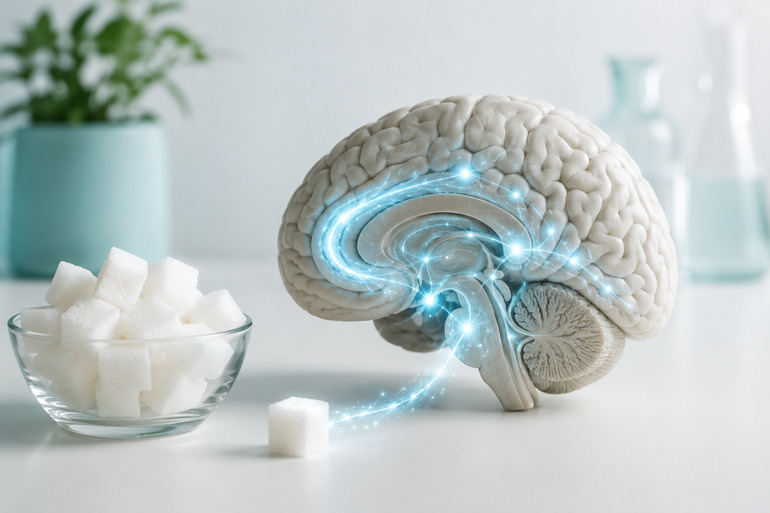
When you eat sugar, your brain releases dopamine, a chemical that signals pleasure and reward. Over time, frequent consumption of highly sweet foods may reduce the rewarding impact of the same foods, potentially contributing to stronger cravings and a preference for sweeter tastes. For some people, reducing sugar intake can initially feel challenging before cravings begin to subside.
What dopamine actually does in your brain
Dopamine is a neurotransmitter, a chemical messenger your brain uses to signal reward, motivation, and pleasure. It is released in response to things your brain considers beneficial: food, social connection, and achievement.
The reward pathway in simple terms
Your brain has a built-in motivation engine called the dopamine reward pathway. When something good happens, dopamine is released within this pathway, creating a feeling of satisfaction that reinforces the behaviour, essentially telling your brain: do that again.
Why your brain treats sugar like a signal
From an evolutionary standpoint, sweet taste meant energy-dense food, a survival advantage. So your brain is wired to respond to sugar with a dopamine hit. Researchers at the Max Planck Institute for Metabolism Research confirm that eating sugary foods activates dopaminergic pathways involved in reward, motivation, and learning.
What happens the moment you eat sugar
Sweet taste can rapidly activate brain reward pathways and contribute to dopamine signaling. This is why the first bite of something sweet feels genuinely good, not just psychologically, but chemically. The effect is real, measurable, and fast.
The response begins within seconds of oral contact with sugar, well before it is digested. This may help explain why some people find sweet-tasting, sugar-free alternatives helpful for managing cravings, a critical insight for anyone using sugar-free alternatives.
Why your cravings keep getting stronger
Here is the catch: your brain adapts.
With repeated stimulation of the dopamine pathway, receptors become less sensitive, a process called dopamine desensitization. Repeated exposure to highly sweet foods may reduce the rewarding impact of the same foods over time, encouraging people to seek greater sweetness or larger portions.
Research from MAC Clinical Research notes that the brain adapts to frequent reward pathway stimulation, requiring progressively greater input to achieve the same positive feeling.
The cycle that keeps you reaching for more
| Step | Trigger | Result |
| 1 | You eat sugar | Dopamine spikes: temporary pleasure |
| 2 | Receptors desensitize | The reward response may become less pronounced over time |
| 3 | Dopamine dips below baseline | Irritability, low mood, craving |
| 4 | You eat more sugar | Cycle repeats, tolerance deepens |
Tolerance builds quietly. You are not consciously choosing to crave more sugar, your brain chemistry is driving it. This is what makes high-sugar habits so persistent and so difficult to disrupt by willpower alone.
Sugar, dopamine, and your mental health
The mood crashes after the spike
Some people experience irritability, fatigue, increased hunger, or difficulty concentrating after consuming large amounts of sugar, particularly when blood sugar levels fluctuate rapidly. This is the “sugar crash,” and it is neurochemical, not just caloric.
What research links sugar to depression
High sugar consumption has been associated with elevated rates of major depressive disorder. Researchers have proposed several possible mechanisms linking high sugar intake to depression, including inflammation, metabolic effects, and changes in reward-related brain signaling. However, the relationship is complex and not fully understood.
If you already experience low mood, reaching for sugar for a quick dopamine boost can make the underlying cycle significantly worse.
How much sugar is too much? (WHO guidelines, simply explained)
The World Health Organization recommends maintaining free sugars less than 10% of total daily energy, roughly 50 g (10 teaspoons) for an average adult. For additional health benefits, the WHO advises aiming below 5%, or around 25 g (6 teaspoons) per day.
| 50 g WHO daily limit (10% of a 2,000 kcal diet) | 25 g Optimal target for additional health benefits |
Most people significantly exceed the recommended limit without realising it, because sugar is hidden in sauces, breads, yogurts, and drinks, not just in obvious sweets.
What happens to your brain when you cut sugar
Does dopamine recover after quitting sugar?
Yes. The dopamine system is neuroplastic; it can recalibrate. Reducing excessive sugar intake may allow reward pathways to become more responsive to less intensely sweet foods over time. Your brain relearns to find reward in lower-stimulation activities and foods.
How long does it take to feel better?
| Timeframe | What Many People Report |
| First week | Increased cravings and desire for sweets |
| Weeks 2-4 | Cravings often become less intense |
| Several weeks to months | Eating patterns and reward responses may continue to normalize |
The upshot
Repeated exposure to highly sweet foods may influence how the brain responds to reward, potentially contributing to cravings and preferences for sweeter tastes over time.
The good news is that this process is reversible. Cutting back on sugar even gradually allows dopamine receptors to recover, cravings to quiet, and mood to stabilize over weeks, not months.
Understanding this mechanism is one of the most powerful tools you have. It reframes cravings not as a failure of willpower, but as a temporary neurochemical adjustment your brain is working through, one you are fully capable of getting to the other side of.
Disclaimer: While sugar activates reward pathways in the brain, scientists continue to debate whether sugar should be classified as addictive in the same way as drugs. Most researchers agree that highly sweet foods can strongly influence eating behaviour and cravings.