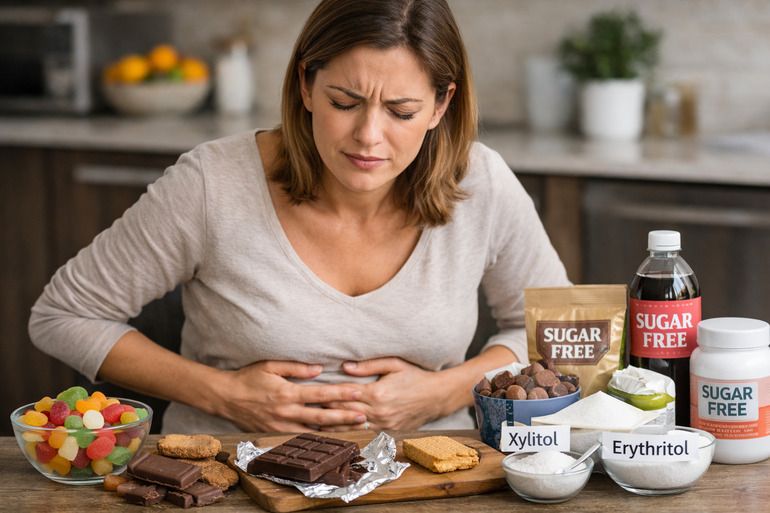
If you’ve ever switched to sugar-free snacks and suddenly felt gassy or uncomfortable, you’re not imagining it. Many people notice sugar alcohols bloating soon after adding “sugar-free” products to their routine. It can feel confusing as these products are marketed as healthier. So why does your stomach react this way?
In this guide, we’ll walk through why sugar alcohols cause bloating, what’s actually happening inside your gut, and how you can still enjoy them without discomfort.
What are sugar alcohols, and where do you find them
Before getting into digestion, it’s important to understand what sugar alcohols really are. Despite the name, they’re not like regular sugar, and they don’t contain alcohol in the way most people think.
They are a type of carbohydrate that provides sweetness with fewer calories. That’s why they’re widely used in “sugar-free” or “low-carb” products.
You’ll commonly find them in:
- Sugar-free candies and chocolates
- Chewing gum
- Protein bars
- Diet desserts
Some common types include sorbitol, xylitol, erythritol, and maltitol.
Sugar alcohols bloating: what’s really happening in your gut
The reason is quite simple once you understand how your body processes these sweeteners.
Unlike regular sugar, sugar alcohols are only partially absorbed in the small intestine. That means a significant portion passes through undigested and ends up in the large intestine.
Once there, a few things happen:
- Gut bacteria begin fermenting them
- Gas is produced during this process
- Water is drawn into the intestines
Together, this leads to the common symptoms people notice:
- Bloating
- Gas
- A feeling of pressure or fullness
Research from the European Food Safety Authority also explains their laxative effect when taken in higher amounts. In other words, the bloating is a predictable response from your digestive system.
Why do sugar alcohols cause bloating more in some people
You might notice that not everyone reacts the same way. One person can eat a sugar-free dessert with no issue, while another feels bloated within minutes. There are a few reasons behind this difference.
Your gut sensitivity
People with sensitive digestion, especially those with IBS, tend to react more strongly. Sugar alcohols are part of FODMAPs, which are known to trigger bloating and gas.
Type of sugar alcohol
Some sugar alcohols are absorbed better than others. The less your body absorbs, the more it reaches your colon, and the more likely it is to cause symptoms.
The amount you consume
Small amounts may go unnoticed, but larger portions can quickly lead to discomfort.
According to the National Institute of Diabetes and Digestive and Kidney Diseases (NIDDK), carbohydrates that are not fully digested in the small intestine pass into the large intestine, where they are fermented by bacteria. This process can lead to gas, bloating, and changes in bowel movements.
Sugar alcohols: digestive side effects you should know
Bloating is usually the first thing people notice, but it’s not the only effect. There are several sugar alcohols with digestive side effects that can show up, especially if intake is high.
These include:
- Gas and flatulence
- Stomach cramps
- Loose stools
- Diarrhea
So if you’re wondering, do sugar alcohols cause gas and diarrhea? Yes, they often do when consumed in excess.
You’ll even see warning labels on some products about laxative effects. It reflects how these ingredients behave in the body.
How much sugar alcohol is too much
This is where things get practical. People often want a clear number, but tolerance really depends on the individual.
Still, there are general ranges:
- Erythritol: usually tolerated better, even at moderate intake
- Xylitol: can cause issues in medium amounts
- Sorbitol and maltitol: often trigger symptoms at lower levels
A simple rule that works for most people: Start small and see how your body reacts. Also, keep in mind that sugar alcohols can add up quickly if you’re eating multiple sugar-free products in a day.
Are sugar alcohols bad for gut health?
This is a common concern, and the answer depends on how they’re used. For most people, sugar alcohols are not harmful when consumed in moderation.
In fact, they can help reduce overall sugar intake, which is a positive.
However, in larger amounts:
- They can disrupt digestion
- They may worsen gut discomfort
- They can make daily eating less enjoyable
So, are sugar alcohols bad for gut health? Not really, but overdoing them can definitely cause problems.
Sugar alcohols vs artificial sweeteners: digestion
People often compare sugar alcohols with artificial sweeteners when choosing between products. The difference becomes clear when you look at digestion.
Sugar alcohols:
- Partially absorbed
- Fermented in the gut
- More likely to cause bloating
Artificial sweeteners (like aspartame or sucralose):
- Usually fully absorbed or passed through
- Minimal fermentation
- Less likely to cause gas
According to the U.S. Food and Drug Administration (FDA), high-intensity sweeteners are used in very small amounts and are either fully absorbed or excreted by the body, which is why they are less likely to cause digestive issues like bloating.
Sugar alcohol types and their effect on bloating
| Sugar Alcohol | Digestion Absorption | Bloating Risk | Notes |
| Erythritol | High (mostly absorbed) | Low | Best tolerated |
| Xylitol | Medium | Moderate | Can cause gas in large amounts |
| Sorbitol | Low | High | Common IBS trigger |
| Maltitol | Low | High | Often causes bloating |
| Mannitol | Low | High | Strong laxative effect |
Tips to avoid bloating from sugar alcohols
You don’t need to eliminate sugar alcohols. A few simple adjustments can help you avoid most of the discomfort.
Try these practical tips:
- Start with small portions
- Don’t combine multiple sugar-free products in one sitting
- Choose erythritol-based options
- Drink enough water
- Pay attention to how your body reacts
A good habit is to treat sugar alcohols like something your body needs to get used to, slow and steady works best.
The upshot
When it comes to sugar alcohols and bloating, the issue is how your body processes them. Since these sweeteners aren’t fully absorbed, they reach the large intestine, where fermentation leads to gas and bloating.
The key takeaway is simple: Most people can take only a small amount of sugar alcohols, but larger portions often lead to discomfort.
You should always choose better options and control your intake so you can enjoy sugar-free products without the side effects.